Wednesday, March 16, 2022

A 11-minute tour de force: An essay on Nagesh in Nammavar

When you have an actor like Nagesh with such a rich body of work, it is easy to forget their roles in films that didn’t achieve commercial success or attain the status of a classic.  Nammavar (1994) was a commercial failure at the time of its release.  Even over the years, it has not attained the kind of cult status as some of Kamal Hassan’s commercial failures have, like Raja Paarvai, Hey! Ram or Anbe Sivam.  If my assessment is correct, the film has a small but loyal fan base.  I think it is a fine film, with a plethora of polished performances.  In sharp contrast to his other films of that period, Kamal, despite headlining the cast, took on a subtly supporting role in many of the scenes, exhibiting just enough emotion to serve as a counterpoint to the more demonstrative acting of others.  This choice worked very well, given his character in the film.  That of a well-meaning but curt professor, one whose brusque nature is more of a self-imposed shield to guard himself from any sympathy or pity owing to his health condition.  The second most impactful performance in this film was that of Gautami’s who essayed her charming role with utmost conviction.  But the actor who, in the span of a few minutes, leaves a lasting impact is one who has been an idol of Kamal all his acting life – Nagesh.

Until the film is past the two-hour mark, there is hardly much of a trace of what is to come from Nagesh.  He plays professor Prabhakar Rao, a pragmatic man, who has resigned to functioning, even if not thriving, in the system that he finds himself in.  Unlike the Kamal character, he does not think that he can effect much of a change and by-and-large, wants to stay out of trouble.  This does not mean that he is morose or world-weary.  On the contrary, he enjoys the little pleasures of life such as dancing with gay abandon with his daughter. (The dance with his daughter has the most heartbreaking of payoffs in the end.) He stands by the Kamal character in the latter’s pursuit of a healthy environment in the college.  But the moment his daughter warns Karan (by suggesting that she will beat him with her slipper), he is slightly nervous and wary of the implications of her act.  Of course, Nagesh, being the consummate actor that he is, just drops hints, saving the true gamut of expressions and gestures until the pre-climax.

The dance sequence with his daughter:

From the time he tentatively enters Kamal’s house, worried about his daughter’s absence till the moment he collapses in anguish at the cemetery, it is a 11-minute extended sequence that is entirely focused on him.  And what an arresting performance he delivers.

When he first enters Kamal’s house, he is apologetic to a fault, seeing Gautami.  To the point that he offers to return later, despite his daughter’s absence.  It is a psychologically acute observation.  Because when we are in despair, we often tend to exhibit that extra bit of tentativeness towards everything.  At the police station though, he erupts when the inspector urges him and Kamal to check whether the girl who was arrested on charges of prostitution is the girl they are looking for.  The force with which Nagesh barks, “Inspector!  You should know whom you are talking to” is the first sign that such an accusation – even if false – is an unforgivable affront to his and his family's dignity.  When he sees his girl in the lockup, he collapses to the chair.  (In order to not disrupt the emotional flow, the scene shifts straight to Kamal’s house, sparing us the police formalities.)

There is a touching visual of Kamal and Nagesh leaning against the gate.  This is again, from a psychological perspective, a delicate nuance.  When we are in the throes of depression, sometimes a quiet moment with a trusted one can offer the kind of solace that words can’t.  In this scene, Nagesh’s voice modulation is masterful.  Listen to the way he says, “Thalai-la ezhuthu” after a pause.
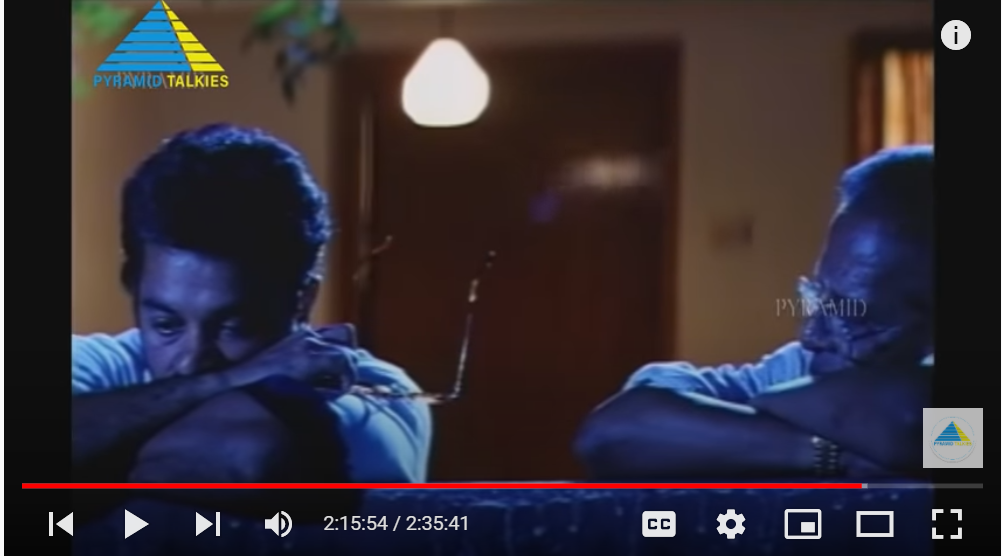

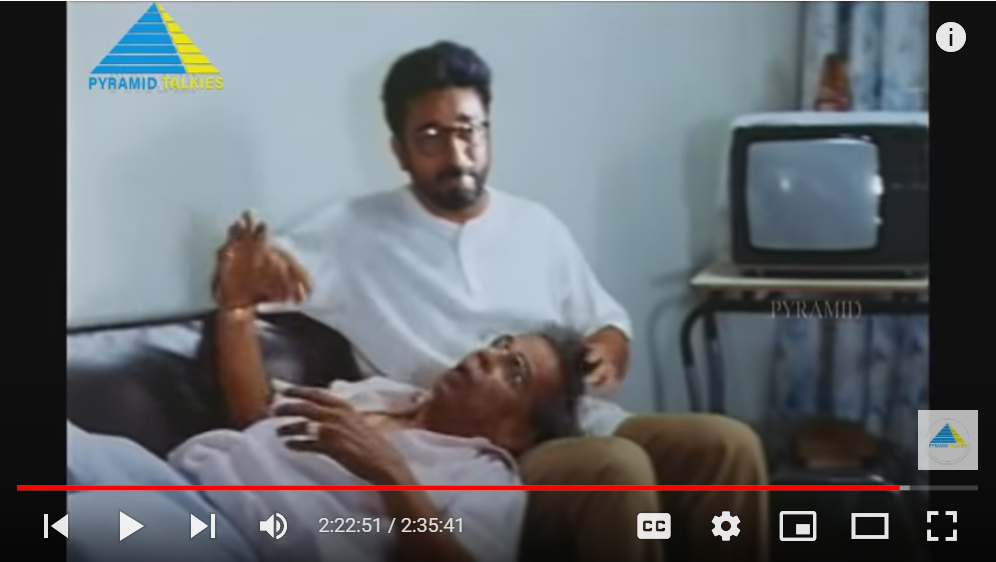
The sequence that opens the next morning is what truly lifts Nagesh’s performance to a different plane altogether.  This is unlike any grieving scene that we have witnessed in Tamil Cinema.  I remember reading that Kamal’s advice to Nagesh was, “You should not cry but you must make the audience cry.”  And how.  Starting with how he grabs Senthil and asks in a commanding tone, “Nirmala-va da?  Nirmala-va?” Nagesh has us in a trance.  Once he enters the house, he does not let out a wail.  Rather he is totally discombobulated.  He does not bother reading her suicide note out loud, as is usually the case in such scenes.  He just tosses it saying, “enna ezhavu da idhu.”  If one of the most poignant visuals of this film is Nagesh lying down on Kamal’s lap, equally moving is how he asks Kamal, “ipo naan ena pannuven?  (Kamal gracefully cedes the spotlight to his senior actor, exhibiting just the right amount of emotion.  Note his response to Nagesh’s statement about death.  It rings true, given that he is battling cancer.)

At the crematorium, the way Nagesh dances, as I noted earlier, is heartrending, given how much he had enjoyed dancing with his daughter.  And after bottling up all the emotions, he completely lets go once he finishes his imaginary dance.  This is the first time he sobs, in the entire sequence.  And it is only the stonehearted that will not join him in his tears.  We, in the audience, feel as emotionally drained as he is.  And is that not the ultimate testament to a great actor? 

In these 11 minutes, Nagesh gives us a glimpse of what made him so special.  The National Award for the best supporting actor was more than a fair reward for his tour de force, for it is a performance that has retained its immortality beyond the actor’s life. 

Click on 'Play' to witness 11 minutes of Nagesh's sustained brilliance:

***

PS: It was Guru Somasundaram’s comment on Nagesh in Nammavar, in his recent interview with Baradwaj Rangan, that spurred me to write this article.

Tuesday, March 1, 2022

Cameos in an ensemble drama

William Shakespeare and lyricist Vaali were absolutely right!  The former wrote, “All the world’s a stage…” while the latter observed, “We are puppets in the hands of the Almighty and he manipulates the strings in the puppetry of our life.” (Pardon me, but that’s my best attempt at translating the “Naayagan melirundhu…” lines from “Ellorum Sollum Paatu.”)  I think of my own life as an ensemble drama.  My microcosm of this world is comprised of a small set of people.  I place a lot of premium on the longevity of relationships.  Like the key characters in a well-made ensemble drama, the core set of people in my life may not be a part of every scene.  But they are an integral, indispensable part of the plot, showing up at key junctures, either by themselves or with others, to add meaning to the drama.  Upon deeper reflection, I also realize that my ‘theater’ has had its share of memorable cameo appearances.  Like Sarojini ma’am from PS Senior Secondary School.  Like the ticket collector on a train in France.  Like Dr. Jim Jamison’s daughter in Memphis.  Like…yes, the list goes on.  But out of respect for your time, I will shed light on just these three cameos. 

It was towards the end of the school year.  I was in fifth standard.  I had a summer vacation that I was really looking forward to.  On that muggy afternoon in April, I was in school, running around with a couple of friends during our PT class when I slipped and fell.  And fell how!  The pudgy kid I was, I gave the phrase, “bend under its own weight” a new meaning in the way I landed on my side, my ear getting smashed against the floor, exacerbated by the fact that my glasses that rested on my ear, broke into pieces.  I don’t quite remember why I was running so fast.  What I remember more vividly was that after hitting the floor with a thud, I could barely limp.  Since there was significant bleeding behind my ear, I was taken by Sarojini ma’am, our PT teacher, to the tiny room towards the front of the school that had first-aid supplies.  While I was given some basic assistance, she also obtained my home number, spoke to my grandma and asked her to pick me up from school to go to the doctor’s office.  She kindly reassured me that I would recover swiftly.  I sobbingly asked her, “Ma’am, I hope I can still go for my summer vacation.”  She laughed out loud, exclaiming, “The annual exams are a week away!  Look what you are worried about!”  She waited until my grandma came.  And upon her arrival, calmly spoke to her, handing over my school bag and walking with me to the car.  The unflappable, unfussy way she handled the whole situation is something I still remember 31 years after it happened.  Thank you, Sarojini ma’am. 

“Merci” and “au revoir” are the only French I know.  That I had to either learn French or play dumb charades better was evident during a summer trip to France.  I was on an overnight train, traveling between two cities.  The air conditioning system in the train must have been designed to simulate life in Antarctica.  When the ticket collector stopped by, I could barely get the ticket out of my pocket to hand over to him.  I quickly realized that we did not have a common language.  I tremblingly murmured, “Cold…cold…”  He thought that I had a cold and in a quizzical tone, he asked, “Cold?” while simulating what sounded like a hybrid of a sneeze and a cough.  In response, I exaggeratedly shivered, shaking my head for good measure!  Rapidly bobbing his head up and down to gesture to me that he understood, he said, "okay, okay, okay, I come back."  He returned in a couple of minutes and handed to me an impeccably folded blanket.  He asked, “This okay?”  I grinned ear to ear, palpably feeling better.  His kindness enveloped me with as much warmth as did the blanket.  Merci, monsieur!

Long-time readers of this blog will know my mentor Dr. Jim Jamison from Memphis.  What you probably don’t know is that his family is just as thoughtful and empathetic as he was.  The news of his passing on was conveyed to me on the phone by one of his sons-in-law, also named Jim.  I was outside a grocery store when he called to share the news.  While I was enormously moved that Dr. Jamison had given my contact information to him in preparation for an inevitability, I was overwhelmed with shock and sadness.  Yes, he had been undergoing treatment for cancer.  And yes, there was a reasonable chance that he may not survive his latest course of treatment.  Nevertheless, the news meant that I had lost a significant person in my life - my mentor, my guide, my moral compass.  I subsequently traveled to Memphis for the memorial service.  While I knew that the magnitude of the family’s grief was humungous, the way they recognized my loss and felt the need to partake in my grieving, was something inexplicably touching.  Referring to Dr. Jamison’s daughter, his son-in-law wrote to me in an e-mail, “Becca wants to make sure you know that you are one of her dad’s kids – part of the family, one of her siblings via mathematics.”  All I can say is that Dr. Jamison would have been smiling from up above.

As I reflect on these people, I must, of course, reiterate that this list of walk-on appearances in ‘The Ram Murali Show’ is too long to capture in one essay.  At the same time, to pause and think of these people and their words, actions and gestures could do two things for us.  Firstly, it could remind us of the stamp of kindness that enables the transfer of positivity among human beings.  And secondly, it could urge us to think about how we could pay that kindness forward.  What Shakespeare and Vaali didn’t tell you, which I will (!), is that while we may be a key character in our own show, we could play impactful cameos in someone else’s!

Saturday, February 5, 2022

Missed Spotlights #9 – Devayani in Azhagi

Thangar Bachan is a filmmaker of strong convictions.  He is known for his outspoken nature.  In his interviews, one can sense his passion for meaningful cinema.  His directorial debut, “Azhagi” just turned 20.  And he has been in the spotlight again, giving multiple interviews, celebrating two decades of what is an undisputed classic.  But for a writer who is so in love with the characters that he created, he scarcely did justice, in his interviews, to one of the thoughtfully etched characters in “Azhagi.”  That is Valarmathi, played with much assurance by a superb Devayani.  Both the characterization and the actor deserve more spotlight.  So, here we go.

The titular character of “Azhagi” is played by Nandita Das.  Her Dhanalakshmi (aka Dhanam) is a character whose life had been filled with unhappy accidents, one of which is a literal one that results in her husband’s death.  She is confined to a life of misery and, contrary to her name, poverty.  She has a chance meeting – the situation leading to the haunting “Un Kuththama” is sublime – with Shanmugam (a marvelously controlled Parthiban), a man with whom she shared a special bond in her childhood and adolescence.  This meeting turns her life around for the better, but the catch is that Shanmugam is now married to Valarmathi.

Whenever there is ‘another’ woman in a man’s life, Tamil Cinema directors usually makes the wife one of two kinds – the meek sufferer or the shrill witch. (If you didn’t instantly think of Vadivukkarasi in “Muthal Mariyathai” for the second category, we cannot be friends!) Valarmathi is neither.  She is immensely kind, thoughtful and loving.  But that she is a person who sets reasonable ground rules is established early on.  When Shanmugam asks her why she made an acquaintance (Shayaji Shinde) wait outside the house, she points to his sozzled state – he would have thrown up all over – and simply states, “If he was in the house, we would have had to wait outside.”  In another, rather terrific scene, she is introduced to Dhanam.  She looks at her in the kindest, most non-judgmental way possible.  Yet when Dhanam addresses Shanmugam by his name, Valarmathi looks befuddled at the familiarity and privilege being assumed.  Devayani is wonderful in this sequence, sporting the perfect puzzled look without overdoing it. (As an aside, she had another great dining table scene in "Bharathi", where she expresses discomfort in a setting that is alien to her.  I shall share both links below to offer a glimpse into this talented actor’s nuanced understanding of the two vastly different roles.)

The perfect puzzled look (Click on 'play' to go to the scene)

In a very unforced manner, Thangar Bachan keeps reminding us of the innate generosity and thoughtfulness of Valarmathi.  This is evident in the scene where she consoles Dhanam for her mother’s brusque manners.  As a result, we never question Valarmathi’s actions or why she grows increasingly insecure about Dhanam.  She trusts her husband.  She even trusts Dhanam.  Yet, as a wife, she is unwilling to let this arrangement continue.  These conflicting emotions are brought out in the bedroom scene prior to the climax.  Devayani is absolutely fabulous here.  The scene stealer that Parthiban usually is, is actually playing a willing second fiddle here.  Right from the way she says, “Why are you looking at me as though you have no idea what I am about to discuss?” till the end of the scene where she leans on him, requesting his understanding, Devayani aces the myriad emotions that her character goes through.  It is a testament to the delicacy of Bachan’s writing that even though she insists on Dhanam leaving the house, we do not, for a moment, despise her.  Because there is a lovely grace note here too.  Valarmathi assures Shanmugam that she will make the necessary arrangements for the education of Dhanam’s son. (That she follows through on this later in the orphanage scene makes the character shine like a diamond.)

The "we need to talk" sequence:

It is worth noting that neither Devayani nor Nandita Das are native Tamil speakers.  It is a testament to their dedication to the craft that everything about their performances – be it their perfect lip sync or their range of expressions – is pitch-perfect.  Some of the modern day actresses who struggle with their lip sync and look clueless and out of place, would do well to learn from these actresses who clearly put in considerable effort to come across as authentic to the characters they were essaying.  

20 years down the line, the performance of Devayani in “Azhagi” remains largely forgotten.  Well, not anymore!

******

The "Bharathi" scene that I cited:

Wednesday, January 19, 2022

The loners stand apart: Thoughts on Halitha Shameem's "Loners"

Writer-Director Halitha Shameem packs a lot into a film.  I don't mean lengthy dialogues or busy frames.  I am referring to the density of thought and intricate detail that she includes in a way that, in her words, is "connection seeking, not attention seeking."  The connection is between not just the lead characters but also between us and the film itself.  Her 30-min segment is titled "Loners" and it is a part of "Putham Puthu Kaalai Vidiyaadha", the latest Tamil anthology on Amazon.  Her love for detailing ensures that nothing comes across as cliched or uninteresting.  The way she stages a wedding that is relayed on Zoom, for instance.  An instrumental version of "Aanandham..." plays unobtrusively in the background.  Nothing significant but the little touches contribute immensely to the verisimilitude that she strives for.  In an online group discussion where supposedly, the point is that the lead pair sees each other again, an elderly lady makes a lovely point about "slowing down", before she signs off.  But such details are the peripherals.  The crux is a poignant, thought-provoking account of a boy and a girl bonding in a deep, giving manner.  That strong crux is akin to the chocolate core of a Cornetto, to use a "Sillu Karupatti" reference, except that the entire contents are a delight to savor, not just the chocolate.

Halitha Shameem's use of English is liberal but it never comes across as artificial or unnecessary.  I truly believe that terms such as "empathy", "vulnerability", "toxic positivity" and phrases such as, "I feel you" might have come across as stilted if translated into Tamil.  The language spoken has to fit the milieu and as was the case with "Sillu Karupatti", the mix of Tamil and English feels completely organic.  Halitha weaves together free-flowing conversations that gradually solidify the bond between the lead characters.

And speaking of the leads, Lijomol Jose and Arjun Das are stupendous.  Having watched Lijomol in "Sivappu Manjal Patchai", "Jai Bhim" (her scene in the commissioner office alone, is worth an acting award) and now "Loners", it is not difficult to predict that she will go places. (Yes, I know I sound like Professor Gnanaprakasm in "Mozhi!") Halitha not only shapes her character but also shapes her performance with a sure hand.  There are two moments in the store sequence that are an exquisite combination of thoughtful writing and splendid acting.  The first is the moment where the characters take off their face masks.  Even though they just met in front of the store, seeing each other after removing their masks feels like a second introductory moment.  And the camera lingers on Lijomol's and Arjun's faces, capturing their bashfulness beautifully. (Without saying anything, the moment makes a statement about how in-person interactions have evolved in the COVID world).  The second is the way Lijomol steals a glance at Arjun when he is looking down.  It is a small yet wonderful bit of acting and staging.  Halitha is fast proving to be an ace in staging these minute moments, trusting us viewers to not miss the nuances.  And Arjun is superbly controlled in the moment where he breaks down, expressing a mix of guilt and regret about his friend.  The importance of catharsis is also brought out in a deeply affecting manner.  Arjun's voice has already become the stuff of legend.  But he is no lazy actor to rest on his innate strength.  Instead, he channels it in service of a well-fleshed out character where he uses his voice to bring out the anguish of the character very effectively.  I hope that the work of these actors opens the doors for many such well-written roles, for they are fully capable of delivering on the trust placed in them.

That Halitha, the writer, is a deep thinker is obvious in the moments such as when Arjun and Lijomol speak about the fake positivity that co-exists uneasily with the tragedy that the pandemic has unleashed on humanity.  But it is a testament to the confidence of the writer that she keeps slipping in important ideas without being overt about them.  A case in point is the way Arjun asks Lijomol if he could join her for her grocery run in person.  He asks first.  She says, yes.  He still takes the effort of asking if she is sure about it.  That little interaction says what we, as a society, need to hear about 'consent' without making a big deal about it.  Even when he proposes an idea for her line of work, he does it with such humility (modestly stating that he is just customizing the concept of open-air theaters) and such dignity, even going as far as to request her to excuse him for any presumptuousness.  That little bit speaks volumes of respect and courtesy that we owe to fellow human beings, without calling undue attention unto itself.  

It is a pleasure to be able to witness the emerging filmography of a filmmaker like Halitha Shameem right from the start of her promising career.  Her "Aelay" did not work for me as well as "Sillu Karupatti" and "Poovarasam Peepee" did.  With "Loners", she has given viewers a deeply fulfilling experience to savor and reflect on, without spoon feeding us.  It is with much anticipation that I look forward to her "Minmini" and other future works because the strains of positivity in her films are addictive in a healthy way, not "toxic"! 

Monday, January 17, 2022

“Bread and jam, please!” – An anecdote and some reflections

“Just give me two days”, was my father’s polite request to me.  On my two-month trip to India in the summer of 2007 – I had quit my job, to start my MBA that Fall - Dad asked that I accompany him to temples in and around Madurai and Trichy.  He said that he wanted me to take two full days out of my trip, travel time included, for this journey where he probably hoped that my piety levels would go beyond chanting ‘Saraswati nabasthubyam’ at every temple regardless of the deity in front of me.  The temple trip itself came a few weeks into my sojourn in Chennai.  By that time, I had indulged myself in a variety of south Indian and north Indian delicacies, both at home and at restaurants.  And a gamut of savory and sweet items had been entertained by my generous palate.  Upon landing in Madurai, the breakfast at the hotel was no different.  I don't remember the menu in too much detail.  All I can say is that lunch felt superfluous.

Oh, I forgot to tell you that I imposed a ‘condition’ - why is that word inextricably linked to Visu and S. Ve. Sekhar?! - on my Dad.  I told him that for the two days in Madurai and Trichy, that I needed breakfast, lunch, tea and dinner at proper times.  You would think that I could take that for granted.  But past trips of this sort had taught me one thing.  When traveling with religious people, their fierce desire to ensure no missed darshans (“thera poatruku” pronouncements were usually as solemn as a dirge) meant that hunger and thirst fell by the wayside.  Not for me.  I need(ed) my calorie intake at regular intervals to prevent me from getting cranky.  On this trip, both Dad and I stuck to our respective promises.  I got my meals on time.  He got His Holiness Yours Truly to ‘religiously’, uncomplainingly follow him to every temple. 

On the second day of the trip, we were to visit the Kasim-Babu brothers, a nadhaswaram-playing duo who lived in Trichy.  Dad was on the phone with them the evening prior to coordinate plans for the next morning.  Mr. Kasim must have apparently shared their menu for brunch.  Because Dad responded, “Oh, idly, dosai, poori, potato.  All this is plenty!”  He stole a glance at me when I said, “Appa, I just want bread and jam, please!”  My rationale was that I had indulged in rich foods all my trip that I wanted a simple breakfast for a change.  But my Dad, whose snicker was effortlessly relayed from Madurai to Trichy over the phone, said to Mr. Kasim, “Oh, my son is saying that he won’t eat all that.  He only wants bread and jam!”  After he kept the phone down, I wondered how it would have been received at the other end.  I always tried extra hard to ensure that people back home would not get the sense that my time away from India had made me the stereotypical, snobbish 'US return' that we have all seen in the movies.  But I thought to myself, “Great!  They are probably wondering, ‘Look at this guy who passes on poori and potato and comes all the way to Trichy to eat bread and jam!’”  That evening, I was sulking endlessly, telling my Dad that he should have offered at least half an explanation for the bread and jam request!  He alternated between laughing it off and assuring me that they would not mistake me. 

The next morning when we went to their house, Mr. Kasim, upon greeting me, said, “Bread jam vaangi vechutom, Pa.  Don’t worry!”  My face turned as red as strawberry jam.  I took great pains to explain myself.  He smiled and said, “Hey, I am just pulling your leg.”  We excused ourselves after a very pleasant couple of hours in their company.  Three years later, I saw him at the upanayanam function of my cousin.  My chief concern was that he shouldn’t remember me as Mr. Bread Jam.  He thankfully didn’t, and just spoke fondly of the nice time that we had at their place. 

Reminiscing about this incident also brought back a spate of emotions and memories of visiting people - especially those older than me - back home.  People whose smiles reached their eye, whose warmth radiated from within their inner core and touched my heart.  I found it enormously touching whenever they would request me to encapsulate the highlights of my life in the intervening years, in a few minutes.  I learned over time that, to them, the gaps between my trips to India were akin to simple ellipses separating two phrases.  And during my time with them, it was their sincere desire to fill in the gaps so that they could feel caught up.  (Sure, technological advances have made the process of keeping in touch easier.  But it is hard to beat the charm of an in-person visit, is it not?)  As I recollect some of the elderly folks who are no longer alive, my heart brims with gratitude for their generosity and thoughtfulness.  The visits themselves may have been short.  But the aftertaste of their generosity lingered for much longer than did the sweetness of the strawberry jam that I sometimes demanded!

Thursday, December 30, 2021

Lords for a day, Masters forever: Thoughts on 83 (the film) and beyond

June 25, 1983.  I was one year and 363 days old.  I had absolutely no clue whether my immediate family had watched the seminal event that was unfolding thousands of miles away at the Lord's cricket ground (in London).  As the entire cricketing world doubted the prospects of an Indian win over the mighty West Indies, 11 Indians, led by a man whose self-doubt was as non-existent as his fear, caused the upset of all upsets.  India won the world cup.  And the nation and the sport were never the same again.

It was only in 1991 that I started following cricket.  It is safe to say that in the last thirty years, my fanaticism and love for the sport has only increased in magnitude.  More importantly (at least to me), I consider myself a student of the history of Indian cricket.  No, I don’t have any academic credentials to show for it.  But I have read reams and reams of literature on Indian cricket, its history and its evolution as well as watched every video cassette, DVD and youtube video that I could possibly access.  And talking of evolution, the 1983 world cup is, without a doubt, the tournament that marked a significant turning point in Indian cricket history.  A nation that had been brought up on Test cricket since the third decade of the century, suddenly woke up to the excitement, the unpredictability, and the instant gratifications of the 50-over version of the game. (That T20 is the flavor du jour of cricket now merits a separate piece!)

One of the chief pleasures – actually, make that two – of watching Kabir Khan’s 83 is the painstaking recreation of the high points of all of India’s games.  I said “two” because on the one hand, we have several moments that have been captured in highlights packages over the years.  These have been recreated on screen with an astounding attention to detail both on the cricketing front as well as on the casting front.  But more importantly, we get to see on screen moments that are not available in the form of highlights.  The first group match versus the West Indies, Srikkanth's square drive in the final, and most memorably, Kapil Dev’s 175* at Turnbridge Wells.  The production values are stupendous.  Anyone familiar with the Lord’s ground (the venue for the final) will know that the stadium has evolved considerably in the past 38 years.  Yet we are transported to that era.  The grounds where games take place, the buses that the players travel in, the hotels they are put up in, all appear incredibly authentic on screen. 

If the production design is a sturdy pillar that holds the film aloft, the superbly cast team of actors are the flying buttresses.  If you observe carefully, the actors don’t just mimic the body language and manner of speaking of the real-life cricketers.  Instead, they impressively embody the spirit and character of the players.  Among the actors with considerable screen time, Ranveer Singh (playing Kapil Dev) and Jiiva (Krishnamachari Srikkanth) don’t just employ tics and impressions to bring their roles to life.  They truly internalize the essence of the players, be it Kapil’s fierce determination or Srikkanth’s charming insouciance. 

Two other actors who deserve a special shout-out are Tahir Raj Bhasin (Sunil Gavaskar) and Pankaj Tripathi (manager PR Man Singh).  Tahir brings to life the buttoned-up, polished Gavaskar.  Watch him in the scene where he clarifies that Yashpal Sharma meant, “acidity” when he actually said, “STD!”  Tahir does not indulge in any tomfoolery.  He just clarifies and gets on with his routine.  He is even better in the restaurant scene with the manager.  He is smarting from a perceived insult, chooses to not talk about it and acknowledges the manager’s efforts to pacify him.  But at the end of the conversation, he politely but firmly makes the point that he will not play the next game.  And Pankaj Tripathi is wonderful as the avuncular manager who has to deal with an eclectic bunch of characters and extend support to his captain.  His reaction to an airport official asking for Viv Richards’ autograph is priceless.

83 is an ambitious film not just in terms of size and scale (which it certainly is).  It also is ambitious in ensuring that despite the minutest of cricketing details being brought forth on screen, that the human angle is not sacrificed.  Of course, not every member of the squad gets a fully fleshed character or an arc but there are several little vignettes that give us glimpses into the human side of this team.  Sunil Valson realizing, while stretching, that he is not going to be selected for a game, is a fine example of how Kabir Khan and his team of writers imbue the characters with genuine emotion, some positive, others not so, but every one of them unfailingly real.

The surge of genuine emotion that I felt projected onto me from the film is, above all the technical mastery, the reason why this movie is and will be very special to me.  What I had read about in books and articles and had watched in highlights and interviews, was crystallized and neatly tied with a bow and presented to me as a 2-hour 40-minute package.  This gift of a film served as yet another reminder of why I truly love this sport and the players that inhabit it.  Yes, I was only two years old when the events of the film happened in real life.  But by the same token, my generation was born several decades after India gained independence.  Do we not feel an outpouring of patriotism and love for our country when we read about Mahatma Gandhi?  History can be relived vicariously through not only written literature but also art forms like cinema.  As a result, it is only natural that as we see a captain hold the world cup trophy aloft on screen, that our own cup of joy brims over.

Saturday, December 18, 2021

Anbodu Kamal Daasan Naan Ezhudhum... - A letter to Rajnikanth

Dear Rajni Sir,

Wish you a belated happy birthday!  I hope that you are recovering well from your recent health issues and that you have a great day and year ahead.  I watched a 30-second video clip today on Twitter.  It is the video of you wishing a girl called Sowmya whom I don’t know.  But your wish was so lovely, so heartwarming that I felt the need to send positive vibes to someone who seems to be going through a health issue.  As always, there was an incredible amount of genuineness in your voice.  The way you said, “kanna” was, as always, a delight to hear.  What was truly poignant to me was the apologetic way you explained why you couldn’t see her in person.  That you were feeling a little under the weather yourself.  There is a reason why your fans adore and worship you.  All that adulation is fully deserved, Sir.

So, am I a Rajni fan or a Kamal fan?  I don’t think you will mind at all, given your admiration for your friend of 46 years.  Kamal Haasan was and continues to be my biggest influence from the world of films.  As an actor, writer and director, he has been a huge reason why I admire and analyze films more than just enjoying and being entertained by them.  How do I see you?  I see you Sir, as a splendid actor who chose to be a shining star.  I am that film buff who was delighted by your performance in the scene in "Kabaali" where you saw Radhika Apte after a long separation.  Your expression of ecstasy in that scene, the way you held her lovingly were all fabulous.  In “Kaala”, the way you tried to pacify your wife in the car (just before she got killed) was a lovely moment.  I thoroughly enjoyed your villainous act as Chitti in “Endhiran”, though I didn’t think that you were utilized that well in the sequel.

The 90s was a decade where the differing paths that you and Kamal had taken were strikingly obvious.  While Kamal acted in films such as “Guna”, “Thevar Magan”, “Mahanadhi” and “Kuruthi Punal” (while alternating with his comedies), your superstardom was established in films such as “Annamalai”, “Baasha” and “Padayappa.”  I enjoyed your performance in all those films, especially “Baasha.”  That was a ‘commercial’ film in which your acting had the kind of raw power that you had also shown in “Thalapathi.”  But in films such as “Muthu” and “Arunachalam” the star obscured the actor in you.  And I felt this way about your later films too.  I would always enjoy an expression here, a nuanced dialogue delivery there.  But the pitch of your performances and the filmmaking style in those films meant that we admirers of your acting had to settle for the occasional glimpse that would make us wistful about the actor of the past.  Did I think that you became a lazy actor?  Not really.  You just seemed keener on appealing to your fanatics’ wishes than the film connoisseur’s tastes. (I shall hasten to add that the two groups are not mutually exclusive.  It’s more about which part of our film brain do we turn on?)

There are three performances in two films that I consider to be your finest work.  The films were,  unsurprisingly, directed by the man whom you named as your favorite director when your guru K Balachander asked you.  Mahendran.  What a magnificent partnership the two of you had.  Without bemoaning the small quantity of films you collaborated on, we are better off celebrating them for their indelible impact.  As Kaali in “Mullum Malarum” and as Johnny and Vidyasagar in “Johnny”, you were astounding.  The nuance of your acting was matched by the sharpness of the writing and the deftness of the filmmaking.  In “Mullum Malarum”, the way you apologized to Shoba is impactful till this day.  The way you uttered, “valichutha ma” twice with different modulations was sublime.  Ditto for the change in your body language in the scene where Sarat Babu (aka “Law Point!”) visits your house.  The erect posture said all that there was to be said about the pride of the character.  I never tire of waxing eloquent on the proposal scene in “Johnny” either.  As you had apparently shared with Mahendran, it was Sridevi’s scene, yes.  But it would just not have worked as well had you not played such a delightful foil.  The “pada padaa-nu pesiteengaLe” line was marvelously delivered by you.  In stark contrast was how you, as Vidyasagar, proposed to the character played by Deepa.  The hurt in your eyes when she uses the word “barber” in a disparaging manner was understated yet supremely effective.  There were films such as “16 Vayathinile” and “AvargaL” where you had an arresting screen presence as the antagonist.  There were other films such as “Aarilirundhu Arupathu Varai” where you shone brightly as an actor.  But these two films with Mahendran are what I will hold dear to me as I think of your work.

One facet of your onscreen persona that I have much respect for is the space that you give to your fellow actors.  Be it villains like the great Raghuvaran, heroines like Ramya Krishnan (in that career-changing turn of hers as Neelambari) or comedians like Janakaraj, Coundamani or Senthil, you have always given your fellow actors the opportunity to shine.  I once watched an interview with Vadivukkarasi where she mentioned that you led an applause after the panchayat scene that left her misty-eyed.  I am sure that there are many more gestures such as that that have left your cast and crew overjoyed.  I doff my hat off to you Sir, for exhibiting more and more humility as you achieved more and more success.  It is a mix that I am sure that you know is as rare as it is deserving of approbation. 

As I come to the end of this letter, let me, once again, wish you a blessed year ahead.  I hope that in your next few films, you give us something that will make us sit up and take notice, once again, of the actor in you.  With the increasingly rousing reception that film goers, your fans included, have been giving to the fresh, well-executed ideas of the new-age filmmakers, I hope that you derive the confidence to go beyond some of the comfort zones in which your superstardom have confined you.  The sounds of your stardom-imposed shackles being broken will be among the sweetest music to your admirers.

Thank you for patiently reading this, Sir.

With much respect,

Ram