Friday, June 17, 2022

C/O Support System

Whenever I see someone on Twitter post a tweet about feeling low, my response invariably involves two words – support system.  I might not know them personally.  But my hope is that my response urges them, if they have not done so already, to tap into their support network.  I don’t think any rule applies to everyone.  But I can aver that a core set of people whom you can bank on for sharing your lows and highs, is a vitally important ingredient in the recipe for peace of mind.  I state this based on experiences, be it my own or shared or observed.  Regardless of whether they are an introvert, ambivert or an extrovert, the ones in whom I observe immense centeredness, are the ones who have a set of people in whom they place tremendous amount of trust.  If this is so simple, why do we not do more of it?  Why do we still feel the burden of the world’s weight on our shoulders from time to time?  Why do we sometimes feel suffocated, heavy, and unable to think clearly?

To begin with, self-reliance, as a concept, is overrated.  Emotional independence is not a binary concept.  Instead, it is a spectrum that has, on the one end, people that have the requisite inner steel to take good care of themselves regardless of the highs or lows that they go through.  In the middle are the ones who rely on others for certain aspects of their lives but are self-sufficient for other matters.  At the other end of the spectrum are ones who have much reliance on a set of people to get through their lives.  Excitement or anguish, for these people, cannot exist in a vacuum.  It must be shared.  Every place in this spectrum has validity.  No position is ‘better’ or ‘worse’ than others.  What matters is that we identify where we are in the spectrum, know when to tap into our inner reserve and when to unhesitatingly seek out the presence of the ones in whom we have entrusted our genuine emotions.

It is equally important for the ones who are a part of others’ support systems to realize where in the spectrum are the ones who seek their support.  If I know that I am an essential part of the support system of someone who really needs me to be an engaged listener on certain aspects of their life, then it behooves me to make time for them when those aspects of their life are amplified in importance.  People seek support in a variety of ways.  Sometimes it is to vent, at other times, it is to seek clarity.  Some seek advice, others seek perspectives from our own lives.  Regardless of what they seek, it is important that we know when to give, and how.  Our preferences don’t matter as much as their needs. 

One thing I especially admire in people who give out support, is their ability to push, coax and prod the recipient to think and identify a solution from within.  As they say, it is better to teach how to fish than buying them fish.  Of course, not all situations might lend itself to that kind of guidance but it is certainly a trait that I admire in people.  I also have tremendous respect for the ones who urge the people they support, to seek professional help, be it psychological, legal or any assistance that would get to the core of their issue.  When someone near and dear gives that sort of advice, we are bound to feel less worried about societal stigmas and antiquated notions.  Of course, as recipients of advice, we would want to filter it through our own sensibilities.  But nevertheless, it is wise to listen to the well-meaning advice of trustworthy people in our life even if it feels like it would take some effort on our part to execute on it.

At the end of the day, a support system, regardless of whether we are a giver or receiver or both, takes time, thoughtfulness and effort.  Support systems take time to blossom.  When they do, it is an absolute pleasure to be a part of them.  When they dissipate, due to reasons ranging from extreme ones such as death to moderate reasons such as incompatibility or milder causes such as lack of proximity or change in geography, it is essential to accept and acknowledge that lacuna and move on.  Of course, it is easier said than done.  But do we always have a choice?

As Emma Thompson observes in the movie Burnt, “There is strength in needing others, not weakness.”  We need to be comfortable with the fact that there will be times in our life that we may need others to help bridge the gap between our current state of mind and a healthier, peaceful state.  Despite all this, yes, we may feel the weight of the world on our shoulders.  But a reliable support system can lend a hand to share that burden.  They might not solve all our problems.  But for a fleeting moment, we can breathe easier, feel lighter and think clearer.  That's a start, not the end.

Thursday, June 2, 2022

Beyond the Cheek: An essay on some unique aspects of Kris Srikkanth

In a world of witty youtube channel names, “Cheeky Cheeka” is just about perfect for former Indian captain and chairman of selectors Kris Srikkanth.  Merriam Webster helpfully defines “cheek” as “insolent boldness and self-assurance.”  If you have watched the best of his innings for India – I rate his 57 versus England in 1985 and his 116 against Australia in 1986, both at Sydney, as his best – you will find it hard to disagree with the attribution.  And beyond the on-field exploits, the insouciance that marks his interviews, speeches and video vignettes, are a delight to many admirers like me.  But Srikkanth is one of those people whose outwardly carefree nature sometimes makes us lose sight of the depth of character.  This essay is an attempt to dig a little deeper, to showcase the depth and profundity that you may have missed.

The 57 vs England (Listen to Bill Lawry exclaim, "He doesn't even run!" at the 57-sec point)

The genesis of this essay was the video he released today about Sachin Tendulkar.  He tosses off detail that another person would have used as an excuse to turn the spotlight unto himself.  Two cases in point from the 1989 tour of Pakistan.  Indian cricket had been embroiled in payment-related issues between the players and the Board. (Srikkanth wrote about it 18 years after it happened.) But when a worried Tendulkar, who was making his debut in the series, approached Srikkanth to discuss the dispute, Srikkanth assured him that he would not be impacted by it.  Srikkanth (30) was nearly twice as old as Sachin (16) back then.  And as a senior, Srikkanth had exhibited an almost paternal attitude towards the kid.  

Ditto for the way Srikkanth, at the start of the series, promised Sachin that he would play all 4 Tests.  This seems insignificant now, given that Sachin’s legend has been cemented for eternity.  But for a 16-year old kid that failed in his first Test (he was out for 15), the security afforded by constancy would have done wonders for his confidence.  Sachin scored his first 50 in the next Test.  And he never looked back.  If you think about the professional setting, when a company is going through a crisis and a leader has his employees’ back and walks the talk, imagine the ease with which the employees can silence the extraneous noise.  That is what Srikkanth did for Tendulkar back then.  True to character, Srikkanth does not dwell on his pivotal role in allaying the concerns of the youngest member of his team.  But I shall dwell away!

The protective attitude was something that Srikkanth extended to not only Sachin but also the seniors who were front and center of the payment dispute.  Srikkanth wrote, years later, that when the then BCCI president urged him to take a second XI team, he flatly refused.  He wrote, rather touchingly, "I was the representative of my players.  At that moment, I wanted to do my best by them.  I could not betray the people whom I might have had differences with from time to time, but who were also the people I considered my mates."  That the Board, in their wise old ways, dropped him for his batting failure in one series – we do know of players being given a slightly longer rope, don’t we? – is a rather unflattering example of the unfairness of the system back then.  Srikkanth, through those two trying years out of the Indian team, maintained a dignified silence.  Of course, when he came back, his form tapered off after a successful WSC series and his career wound down with a whimper.  But if we are focused on higher order things such as character, loyalty and long-term friendship, Srikkanth, by getting dropped, may have lost the battle but he certainly won the war.  The lack of bitterness at his ill treatment and his warm camaraderie with peers like Kapil Dev three decades after the end of his career are all elements of his character that we must not lose sight of. (It was a delight to see these 1983 world cup heroes celebrate his birthday last December.)

Another trait of Srikkanth that we take granted for, is his positivity.  Let’s admit it.  It is hard to be as consistently positive and nonchalant like him.  We dismiss preternaturally positive people as frivolous.  We only do ourselves a disservice by not seeking to emulate that energy.  It is safe to state that Srikkanth’s effervescence is consistent, unforced and intrinsic.  It was on full display in his batting histrionics, it was evident in the way he fielded, it was there to be seen in the way he cheered for bowlers when they took wickets. (Former wicketkeeper Syed Kirmani once ribbed him about wearing spiked shoes and stepping on him in a moment of ecstasy, post a wicket!)  And age has done nothing to rob him off his sparkle.  His commentary style is a reflection of that personality.  When he says “avan” instead of the more respectful sounding “avar”, it is not a sign of disrespect.  Instead, the colloquiality is a byproduct of artlessness.  The heady mix of positivity, cheer and transparency deserves to be treated with respect and admiration instead of being perceived as a lack of seriousness or focus. (For the record, you don’t top-score in two humungous ODI finals without a sense of focus!)  Harsha Bhogle summed it up best when he wrote of Srikkanth, "As a captain and as a person, he never wore a mask and you always knew where you stood with him." 

His mentorship of the subsequent generations of players is another aspect of his personality that seldom gets attention.  From Sadagopan Ramesh to Ravichandran Ashwin, the memories shared of Srikkanth tend to focus on his candor, forthrightness, his genuine advice and generous acknowledgement of their talents.  The great VVS Laxman, in his autobiography, mentions Srikkanth’s encouraging words during a tough phase and how their religious nature helped solidify their bond.  Even outside of cricket, voice artiste and motivational speaker Ilango (he happens to be visually impaired) shared how Srikkanth inspired and created an opportunity for him to channel his strong voice, thereby shedding spotlight on a talent that has luckily not gone unnoticed.

In the movies, we have a subconscious tendency to not treat well-made light films with the respect they deserve.  In society, we tend to often take lighthearted people lightly.  I once read, "lighthearted is not the same as lightweight."  Casualness can coexist with commitment.  Frivolousness can coexist with focus.  Temerity can coexist with thoughtfulness. 

In short, yes, Cheeka may have a surfeit of cheek.  But as an inimitable inspiration, there is nothing that Kris Sri…can’t do!

Thursday, May 12, 2022

Normalizing new normals

Starting in July 2013, I was preparing for a new normal.  I don’t know if I quite thought about it that way at the time, but I think that is what I was doing.  My maternal grandma – I called her Thathamma since I was a toddler until she passed on in 2018 – underwent a bypass surgery in Chennai.  The surgery was a rude shock to her and the family.  The operation was successful and Thathamma recovered quite well.  After moving to the US in 1998, I don’t think I had ever failed to be in active contact with her.  But post her surgery in 2013, I decided that I would call her every day and speak to her at least briefly.  I don’t think I verbalized it, but I interpreted the surgery as a reminder that she was not going to be around forever. 

Thathamma had two children – my mom and my maternal aunt, who was 11 years younger than my mother.  I was very close to my aunt as well.  As I liked to say, my aunt was a sister, friend and mother rolled into one.  Post Thathamma’s surgery, my aunt – who also lived in Chennai – on occasion, would pick up some of my daily calls if she happened to be in the house too.  If I was in a rush, I would tell her, “Shoba, I’ll talk to you later.  Put Thathamma on the phone.  Let me say, Hi.”  Subconsciously, I knew – or I thought so – that I had more time with my aunt than I did with Thathamma.  Then, something unexpected happened.  In October 2016, Shoba passed away, aged 49.  Nobody saw that coming.  I certainly did not.  Yes, she had had some health issues but not for a moment did anyone think that she would die.  She did.  A world without Shoba was not a new normal that I was prepared for.  Nobody in the family or her close circle of friends were, for that matter.  If I had known, I would have prioritized speaking to her on the phone a little more.  But how was I supposed to know?

Over time, I have realized the truth in that wonderful saying about the best laid plans of mice and men going astray.  Not to sound nihilistic, but it is true that there will be times in our life that new normals will be imposed on us.  Through circumstance.  Through fate.  Through destiny.  Through whatever.  If a new normal is unexpectedly positive, we can, of course, rejoice in it.  But if it is not, we are better served accepting it with as much grace as our hearts will allow it.  I am not a perfect man.  I am not always as gracious or as graceful as I would like to be.  But I sincerely believe that the way I went through the grieving process post Shoba’s death was a rare instance where I dealt with an unexpectedly negative development with considerable equanimity.  It was because I realized that the shocking new normal of existence post Shoba’s death was going to be hard for me, yes.  But it was going to be much harder for Shoba’s daughter and Thathamma, who were 12 and 80 respectively, at that time.  Finding inner peace, not happiness, was my immediate goal post Shoba’s death.  I strove, and at times, forced myself to channel my grief in service of those who needed to be shielded from uncontrollable sadness.

We live in a world where there is a tremendous, almost nauseating, emphasis placed on happiness.  The need to look happy, the urge to flaunt one’s happiness through smiles even during instances where inner unrest prevent the smile from reaching the eye.  As I wrote earlier, if we are to place more of a premium on internal peace, we may actually achieve happiness along the way.  Happiness, in a purer form, unsullied by the pressures of society.  I sometimes think that we almost expect and demand that life be a bed of roses.  In my initial phase of living in the US, I remember hearing quite a few of my friends use the phrase, “Shit happens.”  Not the most eloquent, flowery words but it is something that has stayed with me.  Unexpected stuff happens.  Sure, there may be life lessons to be learned if any of it was avoidable.  But in circumstances where things are well and truly beyond our control, we will do ourselves and our loved ones a service by prioritizing two things - outward acceptance of the situation and an inward journey towards finding peace. 

As I reflect on my own life, I know that I am still a work in progress. (Thank you, Will Smith, for that coinage.) As Anu Hasan once remarked, it is not the ones that fall that fail.  It is the ones that don’t get back up that truly fail.  Yes, fate might slap us in the face when we least expect it. (Sorry, Will Smith, for alluding to the Oscar slap!)  But if we can get back up, while lending others a hand, then we might succeed in adjusting to new normals in a fulfilling manner.  

Wednesday, April 27, 2022

The artiste’s voice – an essay on Chinmayi’s voice work in “Satham Podaathey”

The second half of Vasanth’s “Satham Podaathey” is a rather gripping experience.  It is not a thrill-a-minute ride.  Instead, Vasanth painstakingly follows the antagonist (Nitin Sathya) in the latter’s quest to abduct the heroine (Padmapriya).  He locks her up in a room – the lengths to which he goes to make it soundproof are as scary as they are novel.  Eventually it is through a PVC pipe that the protagonist (Prithviraj) discovers the presence of his wife.  This is a truly memorable sequence.  Given the travails of the lead pair, we truly celebrate the reunion.  Yes, the acting and staging are top-notch.  But what deserves the spotlight that was not afforded to it in the 15 years since the movie’s release was the astounding voice work of Chinmayi for Padmapriya. 

In the aforementioned sequence, Chinmayi had to bring to the fore a mix of relief and disorientation in the voice, given the locked-up state of the Padmapriya character.  Her desperate pleas (“Ravi, naan maadi mela iruken”) and her expression of gratitude to her spiritual guru (Note the way she wails, “Ramana ramana…”) are incredibly effective.  If I am correct, I had read that a part of a PVC pipe was brought to the dubbing studio and Chinmayi had to speak into it to simulate the effect.  Such efforts that are in service of a scene to add to the sense of verisimilitude deserve special praise.  As Mahendran once said, in a tribute to Vasanth, a good director is one who lets the film speak for itself during its running time.  But at the same time, makes us think of his efforts after we watch the film.  Vasanth, in his typically understated manner, uses his mastery of sound design to add to the effect of this scene.  In Chinmayi, he finds an ally who brings his vision to life in an emphatic manner.

In another hard-hitting (pun not intended) sequence where Padmapriya is physically abused by Nitin Sathya, the camera shows very little, letting the wails and screams do their job in establishing the plight of Padmapriya.  Again, this is a scene where Chinmayi’s work is powerful.  At the end of the sequence, even the tremulous expressions are just right, without being overdone.

In sharp contrast to these intense scenes are the soft, dignified romantic portions.  The scene that takes the cappuccino is the one in the coffee shop.  If Yuvan’s gentle score wonderfully establishes the character’s growing attraction, Chinmayi’s voice brings out the silent yet palpable desire of the character.  The way she says, “unga mugatha paatha poi solluvenge-nu nenakave illa…” After a pause, she adds, “Paathi poi kooda.”  It is a delightful moment where the line, the actress’ expression, the background score and the voice artiste’s evocative work all combine to create magic on screen.  Ditto for the scene where Padmapriya gifts Prithviraj an embroidered t-shirt.  When asked if the “R” in the shirt refers to his name (Ravichandran), she responds, “I think you are a nice person, you are a wonderful person.”  Such a line can fall flat if not for the right intonation and emphasis.  And Chinmayi nails it, as she does the part where Padmapriya speaks of her guilt (having returned a child to the orphanage).  Again, a vignette that could have become dramatic and overblown is given subtle treatment by the director, with support from his voice artiste.

In recent years, Chinmayi has had to pay a heavy price in her pursuit of justice.  One hopes that justice prevails, even if delayed.  And that movie and music fans can savor a rich body of new work instead of having to go to the past (like I have).  I hope that there comes a day when Chinmayi rejoices in a new normal, a future where injustice is a thing of the past, a new dawn that makes her delete the words, “strangled songbird” from her Twitter profile.  “Satham Podaathey!” – a great movie title, yes.  But that is not what we should say to people who want to come out with the truth. 

Wednesday, April 6, 2022

Triumphant Smiles: A review of "Badhaai Do"

The Sridevi character in English Vinglish watches films to learn the nuances of the language.  While watching a particular film, she comes across the word, “judgmental.”  Puzzled by the word, she requests her niece to explain its meaning.  Later, in a speech, she uses this word in the most appropriate manner possible.  I thought of this while watching Badhaai Do.  To let people be, to let their inner beauty shine, to accept their choices without any judgement whatsoever.  Are these not the ultimate expressions of genuine, unconditional love?  In the case of this exquisitely made film, I walked away with the feeling that the director Harshavardhan Kulkarni and his team of writers are absolutely in love with the lead characters that they have created.  The film is an incredibly important advance in the context of gay and lesbian relationships being portrayed in Indian cinema, with sensitivity, grace and nuance.

One of the film’s biggest strengths is the balance that it strikes between idealism and everyday reality.  The film does not take the easy way out in conjuring a utopian world for its lead characters.  While it acknowledges the gradually changing landscape in India, it also does an astounding job of showcasing the challenges and issues that continue to persist.  One of the fabulously etched arcs in this film is that of the girl’s father (Nitesh Pandey).  At first, he breaks his girl’s heart by failing to understand her or accept her orientation.  But by the end of the film, he realizes the error of his ways and through a small but meaningful gesture, makes peace with her.  By showing the initial, harsh response of the parent, the director gives us an example of how lack of understanding can crush the spirit of a child.  But by showing his transformation, we also get to see how the biggest gift that a parent can give a child is acceptance of their choices in a non-judgmental way. 

Another undeniable plus of this film is the gorgeous way it shows the leads falling in love with their respective partners.  The sequence where Suman (Bhumi Pednekar) makes up an excuse to see Rimjhim (Chum Darang) at the hospital is shot in a delightful manner.  Ditto for the sequence where Shardul (Rajkummar Rao) meets Guru (Gulshan Devaiah) for the first time.  The ecstasy on Shardul’s face and the silent realization that he is falling for someone is wonderfully captured on screen.  The musical score plays no small role in adding to the beauty of these sequences. 

‘Show, don’t tell’ is a rule of thumb that filmmakers are advised to follow.  It is especially difficult in movies such as Badhaai Do where the temptation to editorialize or preach might become hard to resist.  But the director treads this adeptly by just focusing on telling a story and trusting the audience to take away the themes that the film is focused on.  For instance, the adoption angle.  The film establishes Suman as a character who loves and adores children.  The scenes that follow, do their job in establishing the challenges in India for the gay and lesbian community in adopting a child.  But by rooting the whole subplot in Suman’s desire to raise a child, the film becomes less of a commentary and more of a story. 

There is not one false note among any of the performances.  Every actor inhabits their part with much assurance.  Both Rajkummar Rao and Bhumi Pednekar are sublime, especially in the scenes with their respective families after the family members get to know of their orientation.  The way Rajkummar sobbingly hugs his mother is a standout moment.  Bhumi too is astonishingly effective in the late-night scene with her Dad.  Suman’s anguish is conveyed mainly through her quivering voice and silent tears.  There is also a quiet little moment where she sees an infant.  Joy that radiates from within is not easy for an actor to project.  That’s precisely what Bhumi does in this sequence.  Every member of the supporting cast is pitch-perfect too, effortlessly slipping into their roles.  Especially noteworthy is the performance of Sheeba Chaddha, who plays Shardul’s mother.  Her character might not be the brightest bulb, but the guilelessness of the character is brought out beautifully by the actress, sans any overemphasis. 

The final frame of the film feels just perfect.  The smiles of the characters speak volumes.  These smiles aren’t the superficial ones that mark the end of wannabe feel-good films.  These smiles result from the characters achieving the pinnacle of happiness after all their struggles, both within and those imposed by a narrowminded society.  These smiles are a byproduct of finally being able to be with not only their loved ones but also being able to do so with the blessings and wishes of those that mean the world to them.  These smiles reflect a triumphant feeling of the present that gives them hope for a bright future.  By the time the end credits roll, the audience will realize that these smiles are transposed onto them as well.  That infectious positivity is what Badhaai Do radiates so effectively. 

Kudos, team!

Wednesday, March 16, 2022

A 11-minute tour de force: An essay on Nagesh in Nammavar

When you have an actor like Nagesh with such a rich body of work, it is easy to forget their roles in films that didn’t achieve commercial success or attain the status of a classic.  Nammavar (1994) was a commercial failure at the time of its release.  Even over the years, it has not attained the kind of cult status as some of Kamal Hassan’s commercial failures have, like Raja Paarvai, Hey! Ram or Anbe Sivam.  If my assessment is correct, the film has a small but loyal fan base.  I think it is a fine film, with a plethora of polished performances.  In sharp contrast to his other films of that period, Kamal, despite headlining the cast, took on a subtly supporting role in many of the scenes, exhibiting just enough emotion to serve as a counterpoint to the more demonstrative acting of others.  This choice worked very well, given his character in the film.  That of a well-meaning but curt professor, one whose brusque nature is more of a self-imposed shield to guard himself from any sympathy or pity owing to his health condition.  The second most impactful performance in this film was that of Gautami’s who essayed her charming role with utmost conviction.  But the actor who, in the span of a few minutes, leaves a lasting impact is one who has been an idol of Kamal all his acting life – Nagesh.

Until the film is past the two-hour mark, there is hardly much of a trace of what is to come from Nagesh.  He plays professor Prabhakar Rao, a pragmatic man, who has resigned to functioning, even if not thriving, in the system that he finds himself in.  Unlike the Kamal character, he does not think that he can effect much of a change and by-and-large, wants to stay out of trouble.  This does not mean that he is morose or world-weary.  On the contrary, he enjoys the little pleasures of life such as dancing with gay abandon with his daughter. (The dance with his daughter has the most heartbreaking of payoffs in the end.) He stands by the Kamal character in the latter’s pursuit of a healthy environment in the college.  But the moment his daughter warns Karan (by suggesting that she will beat him with her slipper), he is slightly nervous and wary of the implications of her act.  Of course, Nagesh, being the consummate actor that he is, just drops hints, saving the true gamut of expressions and gestures until the pre-climax.

The dance sequence with his daughter:

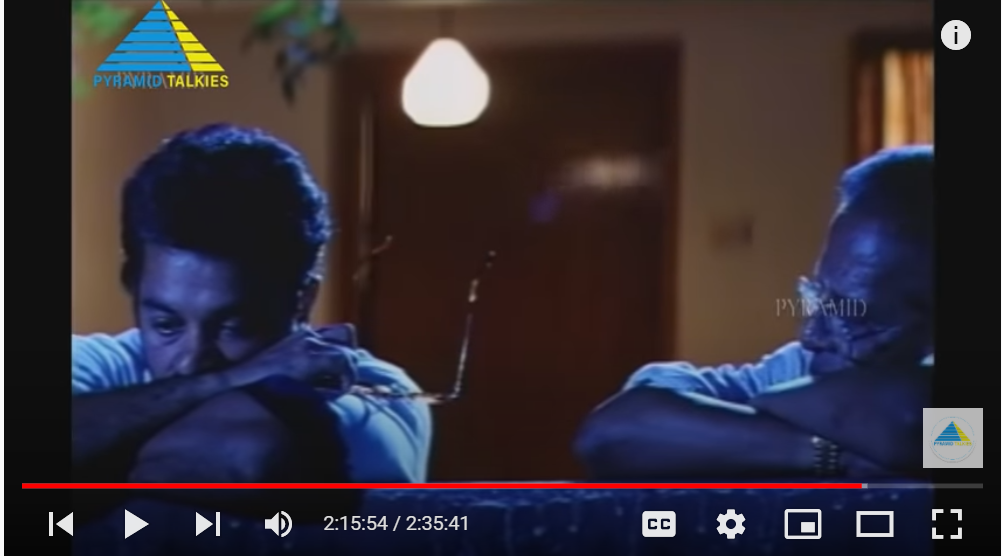
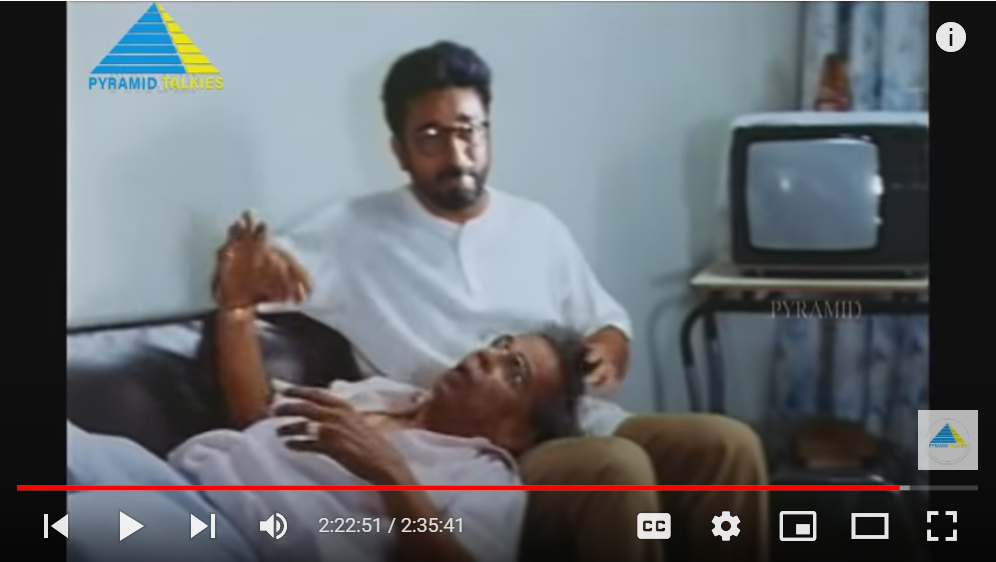
From the time he tentatively enters Kamal’s house, worried about his daughter’s absence till the moment he collapses in anguish at the cemetery, it is a 11-minute extended sequence that is entirely focused on him.  And what an arresting performance he delivers.

When he first enters Kamal’s house, he is apologetic to a fault, seeing Gautami.  To the point that he offers to return later, despite his daughter’s absence.  It is a psychologically acute observation.  Because when we are in despair, we often tend to exhibit that extra bit of tentativeness towards everything.  At the police station though, he erupts when the inspector urges him and Kamal to check whether the girl who was arrested on charges of prostitution is the girl they are looking for.  The force with which Nagesh barks, “Inspector!  You should know whom you are talking to” is the first sign that such an accusation – even if false – is an unforgivable affront to his and his family's dignity.  When he sees his girl in the lockup, he collapses to the chair.  (In order to not disrupt the emotional flow, the scene shifts straight to Kamal’s house, sparing us the police formalities.)

There is a touching visual of Kamal and Nagesh leaning against the gate.  This is again, from a psychological perspective, a delicate nuance.  When we are in the throes of depression, sometimes a quiet moment with a trusted one can offer the kind of solace that words can’t.  In this scene, Nagesh’s voice modulation is masterful.  Listen to the way he says, “Thalai-la ezhuthu” after a pause.


The sequence that opens the next morning is what truly lifts Nagesh’s performance to a different plane altogether.  This is unlike any grieving scene that we have witnessed in Tamil Cinema.  I remember reading that Kamal’s advice to Nagesh was, “You should not cry but you must make the audience cry.”  And how.  Starting with how he grabs Senthil and asks in a commanding tone, “Nirmala-va da?  Nirmala-va?” Nagesh has us in a trance.  Once he enters the house, he does not let out a wail.  Rather he is totally discombobulated.  He does not bother reading her suicide note out loud, as is usually the case in such scenes.  He just tosses it saying, “enna ezhavu da idhu.”  If one of the most poignant visuals of this film is Nagesh lying down on Kamal’s lap, equally moving is how he asks Kamal, “ipo naan ena pannuven?  (Kamal gracefully cedes the spotlight to his senior actor, exhibiting just the right amount of emotion.  Note his response to Nagesh’s statement about death.  It rings true, given that he is battling cancer.)


At the crematorium, the way Nagesh dances, as I noted earlier, is heartrending, given how much he had enjoyed dancing with his daughter.  And after bottling up all the emotions, he completely lets go once he finishes his imaginary dance.  This is the first time he sobs, in the entire sequence.  And it is only the stonehearted that will not join him in his tears.  We, in the audience, feel as emotionally drained as he is.  And is that not the ultimate testament to a great actor? 

In these 11 minutes, Nagesh gives us a glimpse of what made him so special.  The National Award for the best supporting actor was more than a fair reward for his tour de force, for it is a performance that has retained its immortality beyond the actor’s life. 

Click on 'Play' to witness 11 minutes of Nagesh's sustained brilliance:

***

PS: It was Guru Somasundaram’s comment on Nagesh in Nammavar, in his recent interview with Baradwaj Rangan, that spurred me to write this article.

Tuesday, March 1, 2022

Cameos in an ensemble drama

William Shakespeare and lyricist Vaali were absolutely right!  The former wrote, “All the world’s a stage…” while the latter observed, “We are puppets in the hands of the Almighty and he manipulates the strings in the puppetry of our life.” (Pardon me, but that’s my best attempt at translating the “Naayagan melirundhu…” lines from “Ellorum Sollum Paatu.”)  I think of my own life as an ensemble drama.  My microcosm of this world is comprised of a small set of people.  I place a lot of premium on the longevity of relationships.  Like the key characters in a well-made ensemble drama, the core set of people in my life may not be a part of every scene.  But they are an integral, indispensable part of the plot, showing up at key junctures, either by themselves or with others, to add meaning to the drama.  Upon deeper reflection, I also realize that my ‘theater’ has had its share of memorable cameo appearances.  Like Sarojini ma’am from PS Senior Secondary School.  Like the ticket collector on a train in France.  Like Dr. Jim Jamison’s daughter in Memphis.  Like…yes, the list goes on.  But out of respect for your time, I will shed light on just these three cameos. 

It was towards the end of the school year.  I was in fifth standard.  I had a summer vacation that I was really looking forward to.  On that muggy afternoon in April, I was in school, running around with a couple of friends during our PT class when I slipped and fell.  And fell how!  The pudgy kid I was, I gave the phrase, “bend under its own weight” a new meaning in the way I landed on my side, my ear getting smashed against the floor, exacerbated by the fact that my glasses that rested on my ear, broke into pieces.  I don’t quite remember why I was running so fast.  What I remember more vividly was that after hitting the floor with a thud, I could barely limp.  Since there was significant bleeding behind my ear, I was taken by Sarojini ma’am, our PT teacher, to the tiny room towards the front of the school that had first-aid supplies.  While I was given some basic assistance, she also obtained my home number, spoke to my grandma and asked her to pick me up from school to go to the doctor’s office.  She kindly reassured me that I would recover swiftly.  I sobbingly asked her, “Ma’am, I hope I can still go for my summer vacation.”  She laughed out loud, exclaiming, “The annual exams are a week away!  Look what you are worried about!”  She waited until my grandma came.  And upon her arrival, calmly spoke to her, handing over my school bag and walking with me to the car.  The unflappable, unfussy way she handled the whole situation is something I still remember 31 years after it happened.  Thank you, Sarojini ma’am. 

“Merci” and “au revoir” are the only French I know.  That I had to either learn French or play dumb charades better was evident during a summer trip to France.  I was on an overnight train, traveling between two cities.  The air conditioning system in the train must have been designed to simulate life in Antarctica.  When the ticket collector stopped by, I could barely get the ticket out of my pocket to hand over to him.  I quickly realized that we did not have a common language.  I tremblingly murmured, “Cold…cold…”  He thought that I had a cold and in a quizzical tone, he asked, “Cold?” while simulating what sounded like a hybrid of a sneeze and a cough.  In response, I exaggeratedly shivered, shaking my head for good measure!  Rapidly bobbing his head up and down to gesture to me that he understood, he said, "okay, okay, okay, I come back."  He returned in a couple of minutes and handed to me an impeccably folded blanket.  He asked, “This okay?”  I grinned ear to ear, palpably feeling better.  His kindness enveloped me with as much warmth as did the blanket.  Merci, monsieur!

Long-time readers of this blog will know my mentor Dr. Jim Jamison from Memphis.  What you probably don’t know is that his family is just as thoughtful and empathetic as he was.  The news of his passing on was conveyed to me on the phone by one of his sons-in-law, also named Jim.  I was outside a grocery store when he called to share the news.  While I was enormously moved that Dr. Jamison had given my contact information to him in preparation for an inevitability, I was overwhelmed with shock and sadness.  Yes, he had been undergoing treatment for cancer.  And yes, there was a reasonable chance that he may not survive his latest course of treatment.  Nevertheless, the news meant that I had lost a significant person in my life - my mentor, my guide, my moral compass.  I subsequently traveled to Memphis for the memorial service.  While I knew that the magnitude of the family’s grief was humungous, the way they recognized my loss and felt the need to partake in my grieving, was something inexplicably touching.  Referring to Dr. Jamison’s daughter, his son-in-law wrote to me in an e-mail, “Becca wants to make sure you know that you are one of her dad’s kids – part of the family, one of her siblings via mathematics.”  All I can say is that Dr. Jamison would have been smiling from up above.

As I reflect on these people, I must, of course, reiterate that this list of walk-on appearances in ‘The Ram Murali Show’ is too long to capture in one essay.  At the same time, to pause and think of these people and their words, actions and gestures could do two things for us.  Firstly, it could remind us of the stamp of kindness that enables the transfer of positivity among human beings.  And secondly, it could urge us to think about how we could pay that kindness forward.  What Shakespeare and Vaali didn’t tell you, which I will (!), is that while we may be a key character in our own show, we could play impactful cameos in someone else’s!